Knowledge
Hallmarks of Aging
12 hallmarks define our aging process and can be viewed as a 'disease' with the goal of stopping and reversing aging.
Reading time:
15
min.
Created:
Last update:
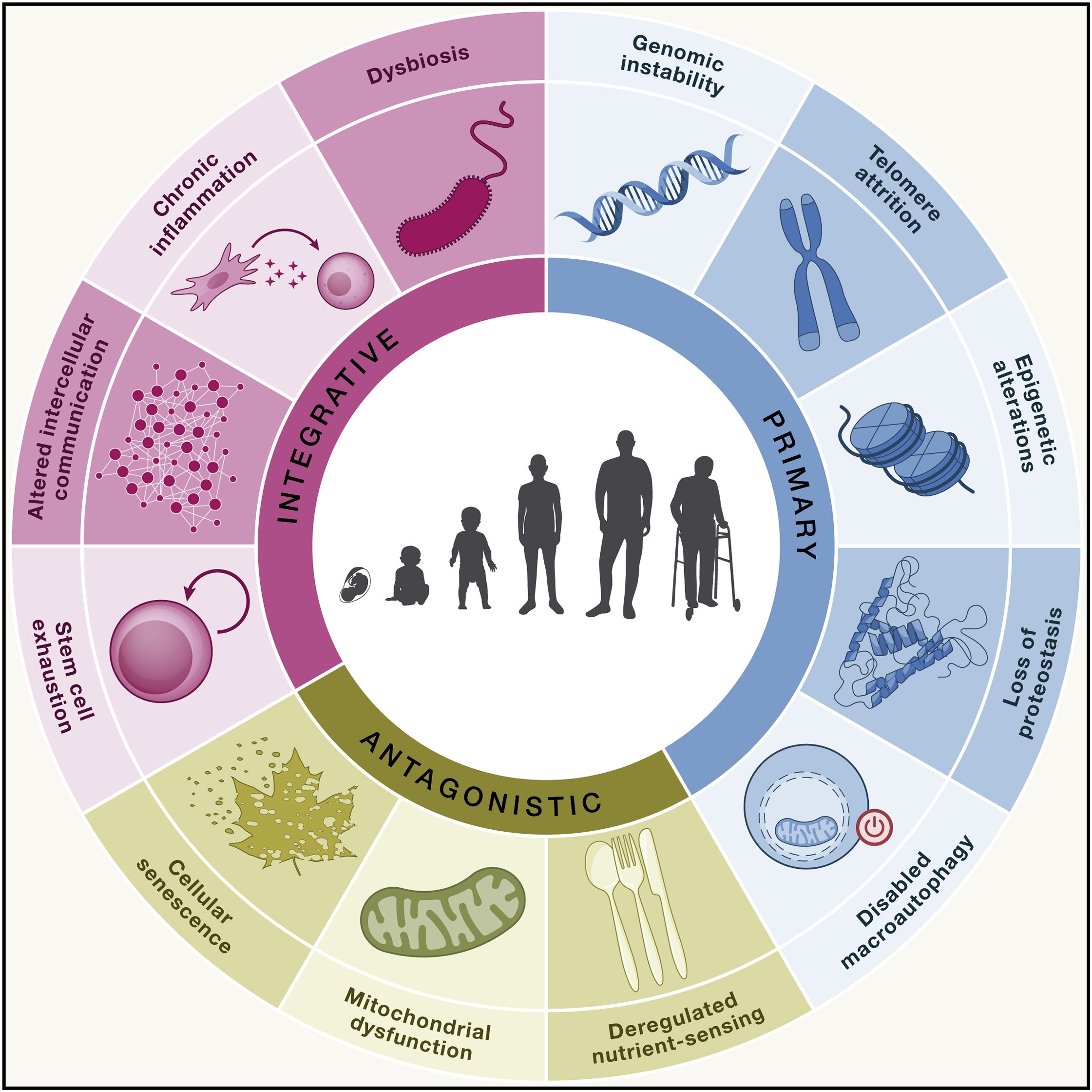
The Twelve Hallmarks of Aging (with brief descriptions):
Genomic Instability: Accumulation of DNA damage caused by environmental and internal factors.
Telomere Attrition: Shortening of chromosome ends leads to cellular senescence.
Epigenetic Alterations: Changes in DNA methylation, histones, and chromatin structure influence gene expression and longevity.
Loss of Proteostasis: Impaired protein folding and removal causes toxic accumulations (e.g., in Alzheimer's disease).
Disabled Macroautophagy: Reduced cellular cleaning of waste and damaged organelles.
Deregulated Nutrient-Sensing: Disruptions in signaling pathways such as Insulin/IGF-1 and mTOR affect metabolism and lifespan.
Mitochondrial Dysfunction: Declining energy production and increased oxidative stress damage cells.
Cellular Senescence: Accumulation of non-dividing cells promotes inflammation and tissue dysfunction.
Stem Cell Exhaustion: Decreased regenerative capacity leads to organ failure.
Altered Intercellular Communication: Miscommunication between cells causes systemic aging effects.
Chronic Inflammation ("Inflammaging"): Underlies many age-related diseases.
Dysbiosis: Age-associated changes in the gut microbiome impair health and immunity.
Key Findings and Discussion:
The article discusses how these hallmarks interact and contribute to age-related diseases. New hallmarks—such as disabled macroautophagy, chronic inflammation, and dysbiosis—expand the model to include microbial and inflammatory aspects. Therapeutic approaches, such as senolytic drugs or microbiome modulation, offer potential for slowing down aging. The authors emphasize the need for interdisciplinary research to validate these hallmarks and utilize them therapeutically.
This expansion of the Hallmarks concept serves as a framework for the study of aging and longevity, with implications for the prevention and treatment of age-associated diseases.
The Authors:
Carlos López-Otín: Biochemistry and Molecular Biology; Professor at the Department of Biochemistry and Molecular Biology, University of Oviedo, and at the IUOPA, Spain. Specialization: Oncology, proteolysis, and aging mechanisms.
Maria A. Blasco: Molecular Biology; Director of the Spanish National Cancer Research Centre (CNIO), Madrid, Spain. Specialization: Telomeres, telomerase, and cancer research in the context of aging.
Linda Partridge: Genetics, Evolution, and Biometry; Weldon Professor of Biometry at the Institute of Healthy Ageing, University College London (UCL), UK, and Founding Director of the Max Planck Institute for Biology of Ageing, Cologne, Germany. Specialization: Genetic mechanisms of aging and longevity.
Manuel Serrano: Biomedicine and Cell Biology; Group Leader at the Institute for Research in Biomedicine (IRB Barcelona), Spain. Specialization: Cellular senescence, regenerative medicine, and aging.
Guido Kroemer: Cell Biology and Immunology; Professor at the Faculté de Médecine, Sorbonne Université, and Head of the Metabolomics and Cellular Biology platforms at the Gustave Roussy Cancer Campus, France. Specialization: Autophagy, apoptosis, and metabolic aspects of aging and cancer.
These experts work interdisciplinarily on cellular and molecular hallmarks of aging, making this article a milestone in gerontology.
Authors